
By Paula Pépin, Founder of GC Collective
The conversation about AI in legal departments has changed. At conferences, roundtables and dinners with colleagues, we’ve moved from asking who is experimenting with AI to discussing how effectively it’s being used—and what it will take to build that capability across an entire legal team.
That shift raises an important question for General Counsel: how do you turn individual experimentation into a shared capability that improves how your department serves the business?
Adopting AI is one step. Building an AI-fluent legal department requires a more deliberate approach to leadership, learning and how work gets done.
AI adoption is accelerating. Fluency takes more work.
Summize’s AI Fluency Report highlights how quickly AI has entered everyday legal practice. The report contrasts 2024 research from ACC and Everlaw, in which 23% of in-house legal professionals reported using AI, with Summize’s survey of 505 in-house legal professionals, all of whom reported using it in their day-to-day work.
These are different surveys with different respondents, so they should not be treated as a direct measure of industry-wide growth. Even with that qualification, the findings reflect a substantial shift in the conversation about how legal work gets done.
But widespread use doesn’t necessarily mean a department is using AI effectively.
An individual lawyer may use AI to draft faster, summarize documents or prepare for a negotiation. Department-wide fluency involves thinking about how those capabilities connect to shared workflows, institutional knowledge and the outcomes Legal needs to deliver.
AI fluency means building the team’s ability to combine technology with legal expertise, business understanding and judgment. It extends beyond proficiency with a particular tool or knowing how to write a better prompt.
Make institutional knowledge part of the process
One finding from Summize’s report particularly caught my attention: much of the organizational context AI needs still depends on manual input.
According to the research, 34.5% of respondents use saved prompts, templates or playbooks to provide context, while another 27.7% manually supply context each time. Only 14.5% have connected AI directly to approved internal knowledge sources.
That creates a practical limitation. A lawyer might be highly proficient with AI, but the relevance of its output still depends heavily on what that individual knows to include.
When policies, precedents, playbooks and institutional knowledge aren’t readily accessible within the process, lawyers have to supply that context themselves. Useful approaches can remain isolated, and the department’s capabilities depend on individual habits rather than shared ways of working.
For GCs, this raises questions worth exploring: where does the team’s most valuable knowledge live? How consistently is it documented? And how could approved knowledge sources support more relevant, consistent AI-assisted work?
Treat AI fluency as a leadership priority
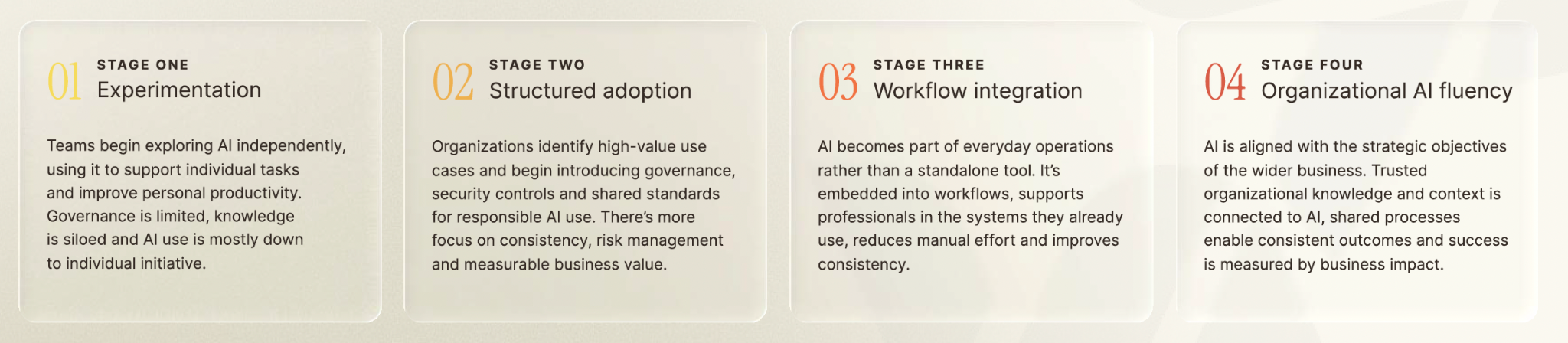
Summize describes four stages in the journey toward AI fluency: individual experimentation, structured adoption, workflow integration and organizational AI fluency.
I find this framework useful because it gives leaders a way to assess where their departments stand. It also makes clear how much must change as a team progresses.
Lawyers need opportunities to question established processes, develop new capabilities and share what they learn. Leaders need to decide which changes deserve attention and how to support them alongside the department’s existing responsibilities.
In my conversations with GCs, the challenge is rarely convincing them that AI matters. Most already recognize that. The harder question is how to lead the change while continuing to meet the everyday demands of the business.
The departments best positioned for the future will, I believe, be led by GCs who can help their people navigate that transition.
Involve your team in deciding what should change
A useful starting point is a conversation about how the department could work differently.
Where is the team spending time on repetitive work? Which processes create unnecessary friction for business partners? Where could better access to shared knowledge improve the quality or consistency of advice?
Involving lawyers in identifying these opportunities gives them a meaningful role in shaping what follows. It also connects experimentation to problems the team recognizes and wants to solve.
Those conversations should make room for uncertainty, too. Lawyers who have spent years developing their expertise may be reconsidering how that expertise will be applied as technology takes on more of the underlying work. Some will find that exciting; others will need more support.
Helping people understand the purpose of the changes—and how their judgment contributes—is part of the GC’s leadership responsibility.
Make room for the work of transformation
Team input needs to translate into clear priorities and practical support.
Choose a few areas where you want to make meaningful progress. Assign people to lead the work, clarify what improvement would look like and give them time to experiment, evaluate results and share their learning.
That may require adjusting workloads, changing expectations or delaying another initiative. We cannot expect lawyers to develop new skills and redesign workflows while carrying exactly the same responsibilities in exactly the same way.
Building AI fluency requires making room for the work of transformation.
The goal is to help useful learning become part of how the department operates, so that progress extends beyond the people who first began experimenting.
Deliberately shape your department’s future
AI is already changing legal work. GCs have an opportunity to shape how that change unfolds within their teams.
As you assess your own department, consider how individual experimentation is contributing to a broader capability. Are people sharing what works? Are you addressing the knowledge and process gaps that limit progress? Have you given the team the direction and capacity to move forward?
For a deeper look at the research and four-stage framework, explore Summize’s AI Fluency Report.
Continue exploring the future of legal leadership
How can GCs lead through change, build stronger teams and bring greater strategic value to the business? In The Modern Legal Leader, Paula Pépin explores the questions shaping senior in-house legal leadership, with practical perspectives informed by her experience and conversations with GCs and CLOs across North America.
Subscribe to The Modern Legal Leader on LinkedIn to receive future editions.
